
Causes and risk factors
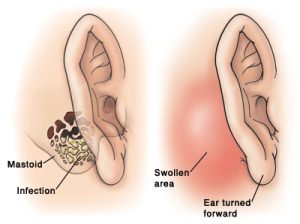
Mastoid is a spongy bone made up of multiple air sacs. Any infection from the middle ear can easily extend into the mastoid bone, thus causing mastoiditis. Untreated acute otitis media is the commonest cause of acute mastoiditis. This infection is commonly observed in children. The common micro-organisms responsible for the infection include Staphylococci, Streptococci, Mycobacterium, and Hemophilus influenza.
Clinical presentation
Acute mastoiditis presents with otorrhea, otalgia, and fever.
Otorrhea refers to drainage from the ear.
Otalgia refers to pain in the ear, which is worse at night.
Fever – persistent high fever.
Other symptoms of mastoiditis are headache and loss of hearing.
Investigations
A blood test is carried out to measure the complete blood cell count.
Audiometry is done to assess the hearing.
Tympanocentesis – This procedure is performed in which the tympanic membrane is punctured and the fluid is tested for culture and sensitivity.
Imaging tests such as x-rays, CT or MRI scan of the head may be suggested.
Treatment
Acute mastoiditis is a serious condition and needs aggressive treatment. The patient is first put on intravenous antibiotics and then shifted to oral antibiotics.
If the infection fails to clear up, then surgical intervention becomes necessary. Partial mastoidectomy is performed, wherein a part of the mastoid bone is removed in order to drain it.
Complications
Acute mastoiditis can give rise to severe complications such as facial paralysis, sepsis, papilledema, necrosis of the bone, brain abscess and even death, if left untreated.
When to contact a doctor
Contact a doctor as soon as you experience ear pain or ear discharge along with fever.
Systems involved
Otology
Organs involved
Ear, brain.