
Causative & risk factors
While in the uterus, the baby’s abdominal wall has a small opening through which the umbilical cord passes. If this opening fails to close immediately after birth, the baby develops umbilical hernia. However umbilical hernias in babies usually close by the age of 1.
Umbilical hernias can also in adults especially where the abdominal wall becomes weakened or overstretched. This happens in obese people and in women who have had multiple pregnancies. History of previous surgery on the abdomen also predisposes to the formation of umbilical hernia. Ascites, chronic cough or constipation can also lead to hernia formation.
Clinical presentation
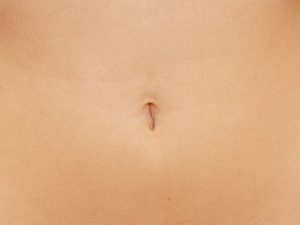
Umbilical hernia appears as a bulge near the umbilicus. The bulge appears on crying, coughing or straining and disappears on lying down flat on the back. Umbilical hernias are usually painless in children but in adults, they can cause discomfort or pain. Occasionally, an umbilical hernia may become obstructed or strangulated. In such cases, the patient will develop fever, vomiting and severe pain in the abdomen. Severe cases can even progress to sepsis or gangrene formation.
Investigations
Diagnosis of umbilical hernia can be made on physical examination. Imaging studies such as USG of the abdomen may be advised.
Treatment
Surgery is the only mode of treatment for umbilical hernia. However surgery is usually not recommended for children unless they are 4 years old. In adults, surgery is recommended in most cases in order to avoid complications.