
Causes and risk factors
Accommodative asthenopia occurs as a result of strain of the ciliary muscle. This arises after excessive close work such as reading or computer use. Presence of underlying refractive errors in the eyes is another cause.
Photogenous asthenopia: Occurs as a result of reading or working in the absence of proper lighting.
Muscular asthenopia: Occurs as a result of extraocular muscle defect, e.g., heterophoria, intermittent heterotropia, convergence insufficiency.
Nervous asthenopia: Occurs due to diseases of the nervous system.
Clinical presentation
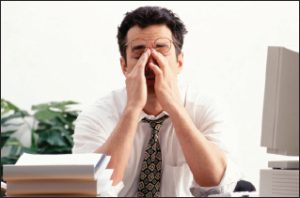
Asthenopia produces discomfort and fatigue in the eyes. The eyes may be excessively dry or start watering profusely (lacrimation). The patient may develop frequent headaches and find it difficult to concentrate. He may suffer from pain or burning in the eye. There may be blurring or dimness of vision and even diplopia (double vision). Photophobia (intolerance of light) may be present. Associated symptoms such as vertigo, nausea, neck pain or facial tics may be present.
Investigations
Asthenopia can easily be diagnosed on the basis of the patient’s history. An ophthalmoscopic examination is performed in order to rule out underlying causes such as refractive errors. A patch test can be performed in order to differentiate between the origin of asthenopia – refractive or muscular.
Treatment
Asthenopia is a self-resolving condition, provided adequate rest is provided to the eyes. A dark room is ideal for allowing the eyes to relax. Cool eye compresses are also effective in relaxing the eyes. Special glasses may be used while doing computer work in order to prevent asthenopia.
Underlying causes contributing to the eye strain such as refractive errors or nerve disorders must be treated.
Other modes of treatment
Frequent blinking and practicing eye exercises regularly help to relieve eye strain and prevent further episodes.
When to contact a doctor
Contact a doctor as soon as you experience symptoms of asthenopia such as fatigue or pain in the eyes, lacrimation, photophobia, etc.
Prevention
The patient is advised to focus his eyes on faraway objects at frequent intervals while doing close work. This helps to avoid instances of asthenopia. Special glasses may be used while doing computer work in order to prevent asthenopia. Practicing eye exercises regularly is also helpful.
Facts and figures
According to a study published in the ‘Indian Journal of Ophthalmology,’ approximately half of the total number of individuals involved in regular computer work suffer from asthenopia.
Systems involved
Ophthalmology, nervous system.
Organs involved
Eyes, nerves.
Image