Causes and risk factors
Coloboma is a genetic disorder. Many patients have a family history of the disorder, however, some don’t. It is an incomplete or improper closure of optic fissure during embryonic development.
It is sometimes associated with other congenital defects in various body parts.
Clinical presentation
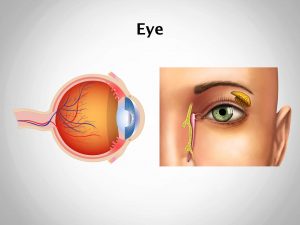
Coloboma can affect any portion of the eye and is hence known by different names accordingly – lens coloboma, eyelid coloboma, optic nerve coloboma, iris coloboma uveal coloboma, etc. It may affect any one eye or both.
The clinical presentation will differ depending upon the location of coloboma.
An iris coloboma will give the characteristic ‘cat-eye’ appearance.
A coloboma of the retina, macula, or optic nerve will produce visual impairment and/or photophobia.
Associated eye problems such as glaucoma, strabismus, nystagmus, etc., may be present.
Investigations
Presence of coloboma can be detected on the basis of an ophthalmoscopic examination. A visual acuity test is performed to check for vision loss.
Treatment
There is no cure for coloboma. Supportive aids are used to enhance vision and hide the defect. Colored contact lenses may be worn to cover an iris coloboma. Surgical intervention may sometimes be suggested.
Complications
Individuals with coloboma have a higher risk of developing cataract and amblyopia in the affected eye. The eye is also at risk of retinal detachment.
When to contact a doctor
Contact a doctor if you suffer from any structural defects in the eye.
Prevention
Being an inherited disorder, it cannot be prevented.
Facts and figures
The estimated prevalence of coloboma is 1 in 10,000 (Stoll et al., 1997). (Source omim.org)
Systems involved
Ophthalmic.
Organs involved
Eye
Recent updates
Kelberman et al. (2014) stated that coloboma is estimated to account for 3% to 11% of blindness in children worldwide. (Source omin.org)